Showing posts with label Books. Show all posts

Thursday, February 18, 2010

Ten Books: Three Tragedies

4. Three Tragedies, by Federico García Lorca
My very first entry for this blog gives you a pretty good idea of the influence of García Lorca on my ideas poetic, theatrical, aesthetic, philosophical, and otherwise. While I love his poetry and his other plays, this is the book through which I met him. Mind you, I don’t necessarily think it’s the best translation it could be, but it made the introduction – and later when I was in Spain and at the apex (so far) of my Spanish-speaking/reading abilities, I read the same plays in the original (with the English translation, a Spanish dictionary, a Spanish/English dictionary, and sometimes my Spanish roommate on hand). Though reading sessions often ended with a headache, I was newly blown away, especially by the boldness of what he had written at a very dangerous time in Spanish history. Much of his work was not only banned until 1953, but because of it (and his homosexuality) he was hunted down, killed, and left in an unmarked grave by Franco’s henchmen when the Spanish Civil War broke out. It was a tragedy then, for his family & for Spain, and it will always be a tragedy for humanity that he died at the not very ripe old age of 36.

The three plays in this volume comprise what many call his “rural trilogy.” In my opinion, they are the height of his humanist work, passionate & compassionate, simple yet complex, insightful & ahead of their time, composed when he was dabbling with surrealism but not yet immersed in it. They are about women in contemporary, rural Spain with towering passions, yet anybody who has read them would agree, I think, that they are about us all. For those who haven’t read them, they are, in order, Bodas de Sangre (Blood Wedding), Yerma, and La Casa de Bernarda Alba (The House of Bernarda Alba).

Next: Mrs. Dalloway, by Virginia Woolf

Saturday, January 16, 2010

Ten Books: To Kill a Mockingbird & Illusions

2. To Kill a Mockingbird, by Harper Lee. I imagine this would be on a lot of people’s lists. It is an American classic, and Atticus Finch (can you guess after whom my Atty Boy was named?) an American icon. Told from the point of view of Scout, who during the action of the novel is a mere six years old, To Kill a Mockingbird tells the story of lessons that a six year old can comprehend, but many adults fail to achieve. While the main story line of Tom Robinson’s trial brings to life the ugly, brutal face of institutionalized American racism, its twin story line of the childrens’ obsessive fear & taunting of Boo Radley works to expand & universalize the themes of maturity, listening to one’s own voice, treating people as individuals rather than monoliths, and plain old kindness and generosity. On reflection, I realize that Atticus has served all these years as a yardstick for my own integrity. What would Atticus do? Gregory Peck, who played the lead role in the movie version (which is nearly as good as the book), fingered Atticus Finch as his favorite out of the more than 25 lead roles in his stellar career.

3. Illusions, by Richard Bach. The books of Richard Bach are fun, well-written specimens every single one. I had first read Jonathan Livingston Seagull when I was very young, and had quite randomly picked it up out of a pile of my older sisters’ abandoned books. In a way, it was written perfectly for a child my age, though I wouldn’t fully comprehend the ramifications of this seemingly simple story for years to come. Perhaps I still don’t; perhaps we can never rest easy that we truly and fully understand anything. To this day, the sight of a seagull brings me a feeling of ease, and I refer to them all as Jonathans, as in “Look, there’s a Jonathan.”

But as much as I hold that first book dear to my heart, it is the next one – Illusions – that entertained, stunned, riveted, and freaked me out all at once. I was an angry, screwed up nineteen-year-old in a severely dysfunctional relationship with an angry screwed up older man. The one healthy thing I took away from that relationship was a taste for literary science fiction (Heinlein, Asimov) & a lot more books read under my belt. At a time when I was absorbing all kinds of new information & furiously trying to figure out who I wanted to be & how to be it, this book (okay, and Stranger in a Strange Land really sticks out, too, but it got booted from the list) held a lot of answers. Granted, they were answers whose code I wouldn’t figure out for years, but I didn’t have to have it all figured out in order for it change the direction of my life.

Because of this book, I decided I wanted to go to New York University, and it was the only college to which I applied. This was very much in contrast to my mother’s nature of constantly hedging her bets, and she tried until it was too late to get me to have backup choices. Part of the application package had to be an essay in which I delineated which book had had the greatest impact on me and why (perhaps it was broader than this, but this is what I remember now). I wrote an essay about Illusions that even inspired my mother. I wish I still had that essay; I would have simply used it as this entry instead of all this blather. Before NYU ever had a chance to change my life (which it did, tremendously), I somehow mustered the confidence to apply, to express something genuine and be rewarded for it.
Next: Three Tragedies, by Federico García Lorca

Monday, December 28, 2009

Ten Books: Black Beauty

A while back, in Treehouse Magazine, editor Tom Robotham recounted the ten books that changed his life, and included a small blurb for each to explain why/how. In it, he encouraged readers to send in their own lists with brief explanations. In trying to compose mine, I found myself writing way too much for what was supposed to be a “blurb.” Anyway, getting the list down to 10 was hard enough. So, I sent in just my list with a quick blurb covering them all (yes, I know, all or nothing – it’s an issue). But, as you’ve probably guessed by now, I’m revisiting that list here. For anybody who might have seen my hastily composed list in Treehouse, it might have changed since then. Really, I could feel differently and draw up a different list next week, next month, next year. But today, this is the one I’ve settled on, and I think most of these would land on my list any given day.

I’ve been a HUGE reader my entire life, but separating favorites from the most influential was easier than I thought. These books are all books that opened my eyes to a new way of thinking/seeing/being, validated something I already felt/knew but didn’t know how to articulate, or sent my life in a new direction. I’m listing them in roughly the order in which they influenced me (in some cases, they didn’t influence me until I’d read them a second time, much later in life than the first time).

Since I wrote the first entry & it was rather lengthy, I decided perhaps I should break this up into multiple entries. I will give you my first entry here, and then the rest in future entries, as I can write them.

And with no further ado, the first book that changed my life:
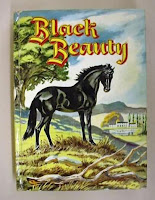
1. Black Beauty, by Anna Sewell. On reflection, I realize that I can credit this book with a lot of things. First, it was the book that drew me to horses. Because of this book, I learned horseback riding at an early age and ended up working with horses in various capacities for years. I could ride western, English, and bareback. I did just about everything one could do with horses, including feeding, grooming, de-worming, leading trail rides, training, and rodeo riding. I taught horseback riding to beginners, trail riders (medium-advanced), and advanced students. I even considered going to a special equestrian college in Pennsylvania (before my love of theater overtook my love of things equestrian).

Second, it developed in me a love, passion, and empathy for all animals. Growing up, my mother once called me the Florence Nightingale of animals (full disclosure: she said this in exasperation, but now I take it as a compliment). In fact, I’d say now that the book engenders & promotes kindness & generosity of every sort, towards humans, animals, plants – any & everything.

Third, though I was already a reader, this book promoted my reading by having promoted my love of horses. During a few years, I practically lived at the local public library, and one day I could no longer find a horse book that I had not read. The librarian recommended Algonquin, a dog book. It was a fine book, and though I liked dogs and all, some part of me recognized that an important era in my growth & development was over.

Fourth, it made me want to write. In fact, I wrote an entire novel as a child, retrieving & hiding it under the cushion of my dad’s favorite chair when I worked on it. I was embarrassed & didn’t want anyone to know that I was writing. Turns out, this instinct was a good one, since when my dad did find out I liked writing, he never ceased to speak sarcastically of “the great American novel” I must be writing. By the way, the novel I wrote was, like the great Black Beauty, written from the point of view of an animal.

Next: To Kill a Mockingbird, by Harper Lee & Illusions, by Richard Bach